
If your calves are naturally small, I know how frustrating it can be. I went through years of training where every body part improved except my calves. No matter how hard I trained them, they always lagged behind.
This guide is not theory or recycled gym advice. It’s based on years of trial and error, learning what didn’t work, and eventually finding a method that finally made my calves grow.
If you’ve tried everything and feel like your calves just won’t respond, this will help you understand why — and what to do differently.
Why My Calves Wouldn’t Grow (And Why This Is Common)
Some people have great calf genetics. Their calves grow quickly, even with basic training. I wasn’t one of those people.
I trained calves:
2 times per week
Warm-up set
2 working sets
Standing calf raises
Seated calf raises
Sometimes leg press calf raises
On paper, it looked fine. In reality, progress was painfully slow.
What I eventually learned is that calves are very different from most other muscles.
Why Traditional Calf Training Often Fails
Your calves work all day, every day.
Walking
Standing
Climbing stairs
Carrying your bodyweight
Because of this, calves become very efficient at repetitive, moderate-rep movements. This is why:
High-rep calf training often stalls
“Burn” doesn’t equal growth
Doing more volume doesn’t always help
I was training calves hard, but I was training them in a way they were already used to.
The Big Realisation That Changed Everything
Once I understood that calves are constantly active, things clicked.
They didn’t need:
More volume
More frequency
More variety
They needed something they weren’t familiar with.
That meant:
Heavier weight
Lower reps
Controlled tempo
True overload
And just as important — enough recovery.
Why I Stopped Training Calves Twice a Week
I originally trained calves twice per week, often alongside leg workouts (I split my legs workouts into thighs and hamstrings). The problem was fatigue.
Leg days are already demanding. Adding calves on top meant:
Rushing sets
Less focus
Less intensity
I eventually moved calves to my shoulder day and put the legs workouts together. At the time, my split was:
Chest
Back
Arms
Shoulders
Legs
Shoulders paired well with calves because:
Calves were fresh
I could train them properly
Recovery improved
From that point on, I trained calves once per week, but with far more intent.
The Exact Calf Training Method That Finally Worked
This is the approach that changed everything for me.
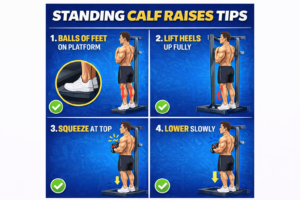
Standing Calf Raises
1 warm-up set of 10–15 reps
Full stretch at the bottom (heels as low as possible)
Slow, controlled raise to the top
No rushing — warm-ups matter
Then:
1 heavy working set
Load heavy enough for 3–5 reps only
Same slow tempo
Full stretch and full contraction
Sometimes I only got 3 reps — that was fine.
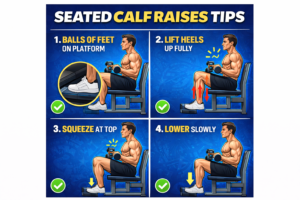
Seated Calf Raises
I followed the same structure:
Warm-up properly
Then 1 very heavy working set
3–6 reps max
This meant I was doing low total volume, but extremely high effort and load.
Why Heavy, Low-Rep Calf Training Worked
This style of training did something my calves weren’t used to.
Instead of endless reps, I was:
Overloading the muscle
Forcing adaptation
Creating a new stimulus
It wasn’t about chasing a pump — it was about progressive tension.
As my calves got stronger, I noticed something important.
How I Progressed the Weight
At first, I stayed in the 3–5 rep range. Over time, as strength improved, I started hitting:
7–8 reps with the same weight
That was my signal.
As soon as reps crept too high, I:
Increased the weight
Dropped reps back into the 3–6 range
That simple rule kept growth going.
How Long It Took to See Real Results
This wasn’t instant.
Around 1 month: I noticed a clear difference compared to previous methods
Over the next few months: My calves visibly changed
People could actually tell I trained them
Before this, it never looked like much effort went into my calves. After sticking to this approach, that changed completely.
Common Calf Training Mistakes I See All the Time
From experience, these hold people back the most:
Training calves like other muscles
Always using high reps
Rushing warm-up sets
Bouncing reps instead of controlling them
Training calves tired at the end of leg day
Never progressing the load
Calves need precision and intent, not just effort.
Does This Work for Everyone?
Genetics still matter — I won’t pretend they don’t.
But if you:
Have stubborn calves
Have tried high reps with little success
Feel like your calves never look trained
This approach gives you a much better chance than standard calf workouts.
Nutrition Still Matters
None of this works without:
Enough calories
Enough protein
Consistent training
Calves are small muscles, but they still need the same recovery support as any other body part.
Final Thoughts
This isn’t a magic hack. It’s simply what worked after years of doing things that didn’t.
If your calves are stubborn, stop trying to out-volume them and start training them in a way they’re not used to. Train them heavy, controlled, and with patience.
That’s how mine finally grew.
More Great Article’s and How to Guides: